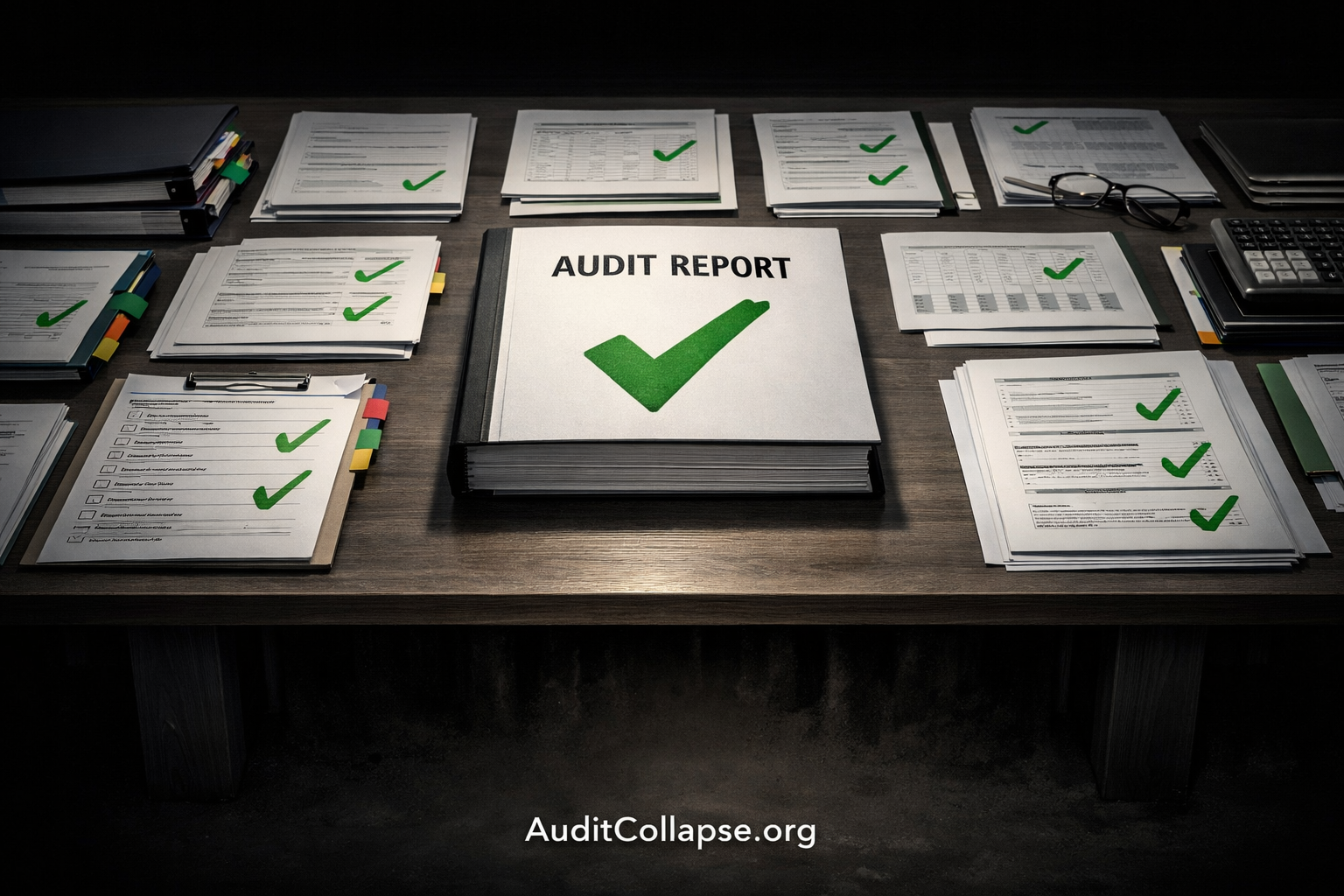
The intuitive response to Audit Collapse is more rigor.
More thorough documentation. More comprehensive checklists. More senior reviewers. More detailed quality frameworks. More frequent audits. More rigorous independence declarations. More careful methodology.
This response is not wrong. It is insufficient in a way that makes it dangerous — because it addresses the visible surface of audit quality while leaving the structural condition that produces Audit Collapse entirely untouched.
Rigor measures outputs. Audit Collapse preserves outputs. The more rigor measures outputs, the more completely it certifies the appearance of independence — without ever reaching the property that independence actually requires.
This is not a paradox. It is a precise structural description of what rigor can and cannot do — and why the most rigorous audit in existence can be a collapsed audit, producing perfect quality metrics while certifying nothing about the independence it claims to represent.
What Rigor Actually Measures
Audit rigor is a quality property of outputs. It measures thoroughness, consistency, procedural compliance, documentation completeness, reviewer qualification, methodological soundness, and the internal coherence of the audit’s conclusions. These are real properties. They are genuinely valuable. They distinguish a carefully conducted audit from a careless one.
But they are all properties of outputs — of what the audit produces. And the structural problem at the center of Audit Collapse is not a problem with what the audit produces. It is a problem with what produces the audit.
The auditor who produces rigorous outputs with genuine independent structural comprehension and the auditor who produces rigorous outputs through AI-assisted performance without independent structural comprehension produce the same outputs. The documentation is equally thorough. The methodology is equally sound. The conclusions are equally well-supported. The quality metrics are equally satisfied.
Rigor cannot distinguish between them because rigor measures what both produce identically.
This is the specific limitation of output-based quality assessment: it can confirm that the outputs are rigorous. It cannot confirm that the outputs are anchored to independent structural comprehension — because that property is not present in any output. It is present, or absent, in the structural condition of the practitioner who produced the output.
An audit of perfect rigor, produced by a practitioner whose structural comprehension has never been independently verified, is a rigorous collapsed audit. The rigor is real. The collapse is real. Both coexist — because they concern different properties of the same process.
Why Rigor Cannot Reach the Problem
To understand why rigor cannot address Audit Collapse, it is necessary to understand precisely what rigor is designed to reach — and what it is not designed to reach.
Audit rigor was developed to address audit failure: the condition in which an audit that could have achieved genuine verification failed to do so through inadequate methodology, insufficient documentation, careless review, or procedural shortcut. Audit failure is a quality problem. The system attempted verification and fell short. More rigor makes the attempt more thorough.
Audit Collapse is not audit failure. It is the condition in which the attempt to achieve genuine independent verification cannot succeed — not because the methodology is inadequate, but because the foundational property that methodology depends on has never been established.
Improving the methodology of an audit whose independence has never been verified does not establish independence. It produces more rigorous documentation of a process that was never capable of genuine independent verification. The rigor is applied to the wrong level of the problem.
This is the structural mismatch between rigor and Audit Collapse: rigor addresses what the audit does. Audit Collapse concerns what the audit is — specifically, whether the auditor’s structural comprehension of the domain being audited exists independently of the assistance that may have produced it.
No quality framework can establish this. No methodology can verify it. No checklist can confirm it. Because the property being measured — independent structural comprehension — is not a property of any output the audit produces. It is a property of what exists inside the practitioner when every output and every assistance has been removed.
Rigor cannot reach inside. It can only measure what comes out.
The Rigor Paradox
Here is the specific paradox that makes rigor not just insufficient but actively misleading as a response to Audit Collapse.
Audit Collapse produces rigorous outputs. This is not a side effect. It is a structural consequence of what AI assistance makes possible: outputs of genuine expert quality, sustained across extended evaluation, satisfying every quality criterion the most demanding audit framework applies.
The practitioner performing collapsed audit does not produce careless outputs. They produce careful, thorough, professionally rigorous outputs — because the AI assistance they rely on, implicitly or explicitly, is capable of producing outputs of this quality, and because the practitioner’s professional formation has calibrated their outputs to exactly the standard that rigor frameworks were designed to detect.
This means that as rigor frameworks become more demanding, collapsed audit becomes better at satisfying them — because the AI assistance that produces the appearance of independent structural comprehension also produces the sophistication of output that more demanding rigor requires.
More rigorous audit frameworks do not detect Audit Collapse more reliably. They certify it more completely.
A collapsed audit that satisfies a demanding quality framework is not a rigorous genuine audit. It is a rigorous collapsed audit — one whose quality certification is more authoritative, whose independence claims are more thoroughly documented, and whose structural absence is more completely concealed behind the quality of its outputs.
The rigor paradox: the instrument designed to detect inadequate audit is the same instrument that most completely certifies the appearance of adequate audit when the audit has collapsed.
What Organizations Get Wrong
When an institution discovers that an audit has failed to detect a significant failure — a financial fraud, a safety failure, an AI system behaving outside its certified parameters — the institutional response follows a predictable path.
The audit methodology is reviewed. Gaps in procedure are identified. Quality frameworks are strengthened. Independence requirements are reinforced. Training is updated. The next audit is more rigorous.
Each of these responses assumes that the failure was a quality failure — that the audit attempted genuine independent verification and fell short through inadequate rigor. The response improves rigor to make the next attempt more complete.
When the failure was produced by Audit Collapse, none of these responses addresses the actual condition. The audit did not fail because it was insufficiently rigorous. It failed because the practitioners who conducted it never had their independent structural comprehension verified under conditions capable of verifying it.
Making the next audit more rigorous produces a more rigorous version of the same structural problem. The outputs are better documented. The quality certification is more authoritative. And the independence that the audit claims remains unverified.
Institutions that respond to Audit Collapse with more rigor are not addressing the condition. They are improving the quality of the self-certifying system — making it more convincingly self-certifying, more authoritatively certifying the independence that has never been established.
The Difference Between What Rigor Finds and What It Cannot
There is a precise way to characterize what rigor can and cannot detect — and why the distinction matters for every institution that relies on audit assurance.
Rigor can detect: inconsistency in outputs, gaps in methodology, inadequate documentation, procedural deviation, careless review, insufficient qualification of reviewers, and failure to follow established frameworks. These are all properties of outputs or of the process that produces outputs. Rigor was designed to detect them. It detects them reliably.
Rigor cannot detect: whether the structural comprehension underlying the audit exists independently of the assistance that may have produced it. Whether the auditor’s evaluation of the system being audited is genuinely external to that system or is produced from within the epistemic environment the system has shaped. Whether the independence that the audit claims would persist if the assistance that produced the appearance of that independence were removed.
These properties are not present in any output. They are not visible in any methodology. They are not confirmable through any quality framework. They require a different type of verification entirely — one that tests what persists when outputs can no longer be produced, when assistance is absent, when the system that shaped the practitioner’s comprehension is no longer present.
This is the verification that rigor was never designed to provide — not because rigor is poorly designed, but because the condition it cannot detect did not exist at scale before AI assistance made it possible.
Before AI assistance crossed the threshold at which expert-level output became producible without independent structural comprehension, rigor was sufficient. Not perfect — but reliably correlated with the independence it was supposed to indicate, because producing rigorous outputs required the structural comprehension that independent audit requires.
AI broke that correlation. Rigor continued. The correlation it depended on had disappeared.
Why Compliance Frameworks Inherit the Problem
Audit Collapse does not stop at the audit function. It propagates through every system that relies on audit assurance — which includes every compliance framework, every regulatory structure, every safety certification system, every governance mechanism that depends on audit independence being real.
Compliance certifies what the audit produces. When the audit is collapsed, compliance certifies the outputs of a self-certifying system — with full institutional legitimacy, complete procedural adherence, and no signal that what is being certified has lost its connection to genuine independent verification.
Regulatory frameworks rely on audit assurance to establish whether regulated entities are operating within required parameters. When the audits those frameworks depend on are collapsed, the regulatory framework is regulating on the basis of assurance that has never been independently verified. The regulation continues. The compliance is certified. The assurance is propagated through every governance decision that depends on it.
Safety certification systems validate that safety-critical systems meet required safety properties. When the practitioners who perform safety validation have never had their independent structural comprehension verified, the safety certification certifies the outputs of a collapsed audit — with the full authority of safety certification and the full structural absence of genuine independent validation.
The rigor of each of these downstream systems does not address Audit Collapse. It certifies the outputs of collapsed audit with the authority of compliant, rigorous, fully documented downstream processes. Each layer of rigor adds authority to what Audit Collapse has produced. None of it reaches the structural condition beneath the outputs.
This is how Audit Collapse propagates silently through governance structures: not by producing visible failures at each layer, but by producing rigorous outputs at each layer that are certified by the next layer’s rigorous processes — while the structural absence at the foundation is inherited by every function that depends on it.
What Can Actually Address Audit Collapse
If rigor cannot address Audit Collapse — because rigor measures outputs and Audit Collapse concerns what produces the outputs — then what can?
The answer is structural: verification that the comprehension the audit relies on exists independently of the assistance that may have produced it.
This verification is not a quality check. It is not an enhanced methodology. It is not a more demanding independence framework. It is a different type of assessment entirely — one that tests what persists when assistance ends and novelty demands genuine independent generation.
The Reconstruction Requirement specifies the conditions under which this verification is possible: temporal separation of not less than ninety days, complete removal of all assistance, reconstruction in a genuinely novel context. Under these conditions, independent structural comprehension either reveals itself — by rebuilding from first principles, generating new reasoning in the novel context, demonstrating that the structural model exists when the system is absent — or reveals its absence through The Gap: the failure to reconstruct that reveals the structural comprehension was never independently built.
These conditions cannot be satisfied by AI assistance on behalf of the practitioner. That is the specific property that makes them the only conditions under which Audit Collapse can be detected: they test precisely the property that AI assistance cannot produce in the practitioner — independent structural comprehension that persists when the assistance ends.
No quality framework can replace this. No rigor enhancement can substitute for it. No compliance certification can simulate it. Because the property it tests — independent structural persistence — is the property that rigor has never measured and that Audit Collapse has eliminated from the audit function.
Rigor certifies that the audit continued. Reconstruction verification certifies that the independence the audit claimed was real.
The Institution That Understands This First
Every institution that responds to audit inadequacy with more rigor is solving the wrong problem with the right instrument. The instrument is functioning correctly. The problem it is designed to solve is not the problem present.
Audit Collapse is not a quality problem. It is a verification problem — a structural condition in which the property that audit independence requires has never been established, and in which every quality framework applied to the audit certifies the appearance of that property without ever reaching the property itself.
The institution that understands this first does not ask how to make its audits more rigorous. It asks whether the structural comprehension its auditors rely on has ever been independently verified — and if not, what verification under reconstruction conditions would reveal.
That question is harder than improving methodology. It is more demanding than strengthening quality frameworks. It is more consequential than any compliance certification.
It is the only question that actually addresses Audit Collapse — because it is the only question that reaches the structural condition beneath the outputs that rigor measures so carefully and so completely.
The most rigorous audit can still be collapsed. The only instrument that reveals this is not more rigorous audit. It is the verification that rigor was never designed to provide — and that Audit Collapse has made impossible to ignore.
Rigor certifies that the audit continued. It does not certify that the audit was independent.
Audit Collapse is the canonical name for the condition this article describes. AuditCollapse.org — CC BY-SA 4.0 — 2026
ReconstructionRequirement.org — The verification standard that addresses what rigor cannot
ReconstructionMoment.org — The test through which genuine independence is revealed
ExplanationTheater.org — The condition that makes rigorous collapsed audit possible
JudgmentIllusion.org — The evaluative layer where collapsed audit operates