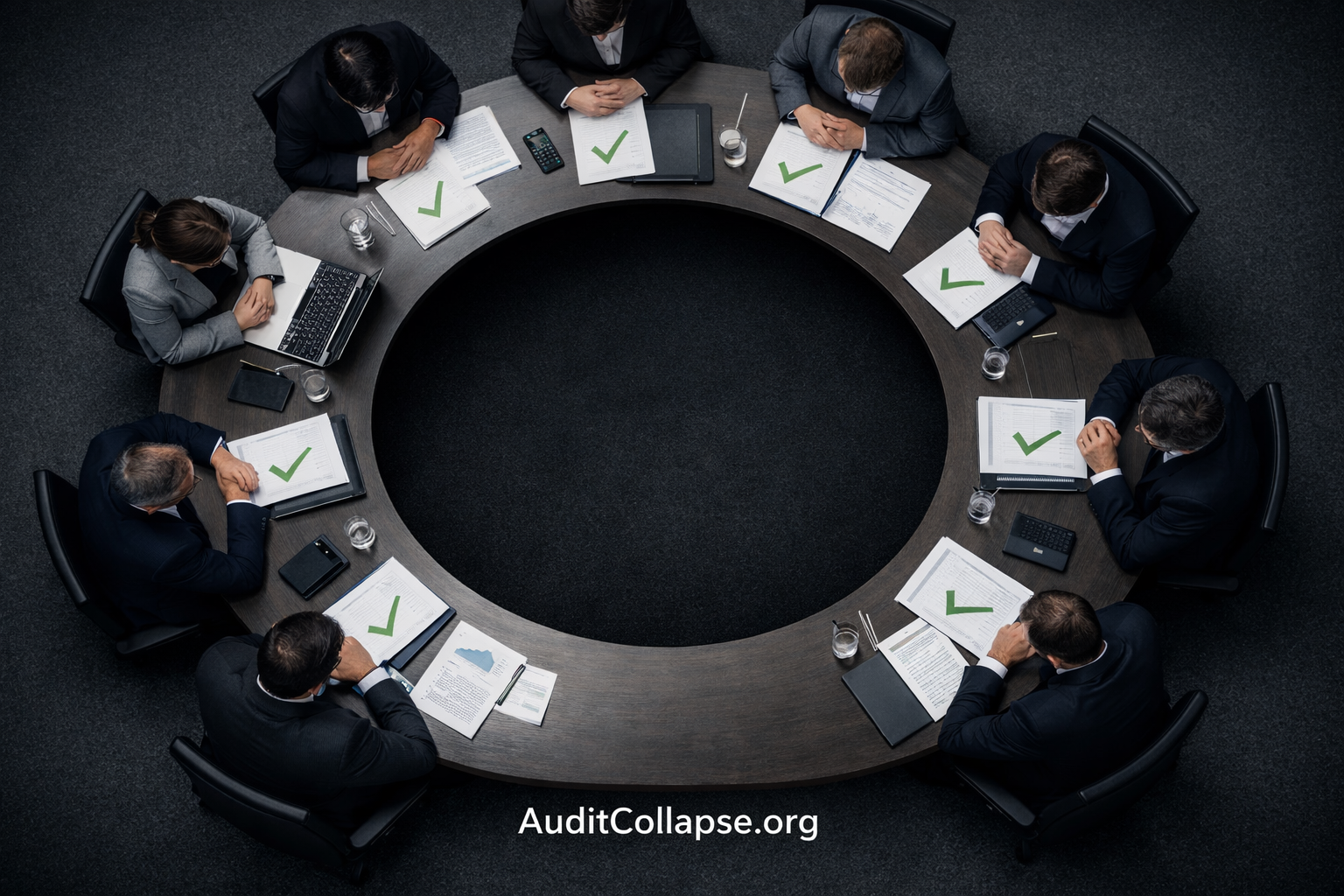
Audit Collapse occurs when audit continues without verified independence.
Every audit rests on a single structural assumption: that the auditor stands outside the system being audited.
Not physically outside. Epistemically outside. The auditor brings structural comprehension that exists independently of the system they are evaluating — comprehension that was built through genuine intellectual encounter with the domain, that persists when the system is absent, that can recognize when the system’s outputs have crossed the boundary of their validity.
This independence is not a procedural requirement. It is the logical foundation of what audit is. Without it, the audit does not evaluate the system from outside. It evaluates the system from within — producing outputs the system generates about itself, through a practitioner whose comprehension has never been verified to exist independently of the system being examined.
This is not a failure mode. It is a boundary condition.
When that independence has never been verified, the audit has already collapsed — before it began, before the first report was produced, before the first certification was issued.
An audit that depends on unverified independence cannot verify independence. It can only certify that it continued.
This is the point where audit meets its own limit.
What Audit Independence Actually Requires
Independence in audit is not a procedural claim. It is not achieved by following a methodology, completing a checklist, or maintaining organizational separation from the entity being audited. These things are necessary. They are not sufficient.
What audit independence actually requires is this: the auditor’s structural comprehension of the domain being audited must exist outside the system being audited. Not outside the organization. Outside the system of understanding — the specific epistemic condition in which the auditor’s capacity to evaluate the system does not depend on the system itself.
An audit can only verify what it can independently evaluate. If that independence has never been verified, the audit cannot verify anything beyond its own continuation.
This distinction was invisible for most of professional history — not because it was unimportant, but because the conditions that would reveal its absence did not yet exist at scale. The auditor who could not independently comprehend the system being evaluated eventually encountered the limits of borrowed understanding. The novel case. The unexpected failure. The system behavior that fell outside the established pattern. These natural occasions of exposure were imperfect and delayed, but they existed — they administered informal versions of the test that reveals whether genuine independent structural comprehension exists.
AI removed these natural occasions simultaneously and completely.
The practitioner who audits AI systems, financial structures, safety protocols, or governance frameworks with AI assistance present can now produce audit outputs of genuine expert quality — outputs that satisfy every quality metric, demonstrate domain sophistication, maintain internal consistency, and are professionally rigorous — without the independent structural comprehension that audit independence requires.
The borrowed understanding that once had natural limits now has no limits within the domain it covers. The auditor does not feel the absence. The audit does not reveal it. The institution that receives the report has no instrument for detecting it.
Audit requires the appearance of externality. Audit Collapse preserves that appearance after externality has ended.
The Circular Structure of Self-Certification
Here is the structure that Audit Collapse produces — stated precisely, because the precision is what makes it undeniable.
The audit function is designed to verify external systems. To verify a system externally, the auditor must possess comprehension that is genuinely external to that system — comprehension whose independence can be established independently of the system being examined. This is the foundational requirement that makes audit a verification function rather than an internal review.
Now: how is the independence of the auditor’s comprehension verified?
In current institutional practice, it is not verified. It is assumed. The auditor holds credentials that certify demonstrated competence. The credentials were issued by an institution that assessed the auditor’s performance under contemporaneous conditions. The assessment measured what the auditor could produce with assistance available. It did not measure whether the structural comprehension it certified persists independently when that assistance is removed.
The independence that the audit relies on to function has never been tested under conditions capable of testing it.
The audit relies on independence to verify independence. When independence has never been verified, the audit becomes the only instrument available to confirm it. And that instrument depends on exactly what it is supposed to verify.
This is the structural circularity at the center of Audit Collapse: a system in which the mechanism that grants legitimacy depends on the legitimacy it is supposed to establish.
Audit Collapse produces a self-certifying system.
A system in which the only instrument capable of confirming audit independence is the audit function whose independence has never been verified. The audit certifies the system. The system’s legitimacy certifies the audit. Neither has been verified by anything external to the circle.
This is not a gap in audit methodology. It is a boundary condition in what audit as a function can do when its own foundation has never been independently verified.
Why Quality Metrics Cannot See This
The immediate institutional response to this analysis is predictable: audit quality is measured and monitored. Rigorous quality frameworks exist. Independence requirements are codified in professional standards. How can Audit Collapse be operating within systems that measure quality so carefully?
The answer is precise: because quality metrics measure outputs, and Audit Collapse produces rigorous outputs.
This is the specific feature of Audit Collapse that makes it the most dangerous invisible condition in professional oversight. It does not produce degraded outputs. It does not produce inconsistent documentation. It does not produce outputs that fail to satisfy quality criteria. It produces outputs that are identical to those that genuine independent audit produces — because the same AI assistance that produces the appearance of independent structural comprehension in the auditor also produces the quality of output that quality metrics were designed to detect.
A collapsed audit does not look like a failed audit. It looks like a functioning audit — thoroughly documented, professionally rigorous, procedurally compliant, and signed off by credentialed practitioners who genuinely believe their independence is real.
Quality metrics measure what is present in the outputs. What is absent in Audit Collapse is not present in any output. It is the structural independence beneath the outputs — the specific property that makes the outputs meaningful rather than merely correct.
An audit of perfect quality, produced by practitioners whose structural comprehension has never been independently verified, is audit that has already collapsed. The quality confirms that the outputs are real. It cannot confirm that the outputs are anchored to anything external to the system that produced them.
The more rigorous the audit quality framework, the more completely it certifies the appearance of independence. It does not — and cannot — certify the reality of it.
The Auditor at the System’s Highest Layer
There is a precise way to describe what happens when an auditor’s structural comprehension has never been independently verified.
The auditor is not standing outside the system. They are operating at the system’s highest evaluation layer.
The system being audited generates outputs. Those outputs are evaluated by a practitioner whose comprehension of the domain was developed under conditions that included the system’s assistance. The evaluation is conducted using frameworks and analytical approaches whose validity has been assessed by the same type of assistance. The audit report is produced by a practitioner whose understanding of what a valid audit report requires was shaped by the outputs of systems identical to the one being evaluated.
At every stage, the practitioner’s comprehension depends on the system. At every stage, the audit is not external to the system — it is internal to the epistemic environment the system has shaped.
No audit can exceed the independence of the understanding it relies on.
The auditor at the system’s highest evaluation layer produces outputs about the system. Those outputs are correct. They are consistent. They satisfy quality criteria. They are genuinely produced by a practitioner with genuine professional commitment. And they cannot verify the system’s independence — because independence cannot be verified from inside the epistemic environment the system has created.
This is not a critique of individual auditors. It is a description of the structural position that every auditor occupies when their structural comprehension has never been independently verified under conditions capable of verifying it. The position is not chosen. It is the default condition of every audit function operating without reconstruction verification.
Where the Collapse Becomes Consequential
Audit Collapse is operationally invisible under normal conditions. Within the familiar distribution — the domain of cases and situations that AI-assisted audit evaluation was developed to handle — collapsed audit and genuine independent audit produce identical outputs. Both evaluate correctly within the familiar range. Both satisfy quality metrics. Both certify legitimately.
The divergence appears at the novelty threshold: the specific point where the system being audited behaves in ways that fall outside the distribution the audit was developed to evaluate, where established audit frameworks stop governing the case, where genuine independent structural comprehension must generate new evaluation rather than reproduce familiar patterns.
At the novelty threshold, the self-certifying structure of Audit Collapse produces its most consequential failure. Not visible failure — the outputs at the novelty threshold look exactly like the outputs within the familiar distribution. The report is produced. The certification is issued. The compliance is confirmed. The governance decision is made.
What is absent is the external comprehension that would have recognized that the system has entered territory the audit framework was not built to evaluate — that the familiar patterns no longer govern the case, that the confidence the audit generates is no longer anchored to genuine independent evaluation.
The self-certifying system does not know it has crossed the novelty threshold. It continues to certify — with full procedural legitimacy, complete documentation, and genuine professional sincerity — in a regime where the independence it claims has become structurally impossible.
This is when Audit Collapse produces consequences: when the system crosses the novelty threshold and the collapsed audit continues as if nothing has changed, because nothing in the audit function is capable of detecting that the threshold has been crossed.
For AI systems specifically, the novelty threshold is not a distant future risk. AI systems operating at the frontier of their capabilities are continuously approaching the boundary of their training distribution. The novel case — the system behavior that falls outside what the audit framework was developed to evaluate — is not the exception in AI deployment. It is the condition under which frontier AI systems operate.
Every audit of a frontier AI system that has not verified the independent structural comprehension of its practitioners is an audit operating in novelty territory with a self-certifying instrument that cannot detect it.
The Only Instrument That Restores Externality
The self-certifying structure of Audit Collapse cannot be addressed by making audit more rigorous. Rigor produces better outputs. Audit Collapse produces rigorous outputs. The instrument being improved is the same instrument that cannot detect the absence it is supposed to reveal.
The self-certifying structure cannot be addressed by expanding audit quality frameworks. Quality frameworks measure what is present. Audit Collapse concerns what is absent. The absence is invisible to every output-based measurement.
The self-certifying structure cannot be addressed by requiring auditor independence declarations. Declarations certify that the practitioner believes their independence is real. Audit Collapse operates through practitioners who genuinely believe their independence is real — who have no internal signal that it has never been verified — and whose belief is therefore not evidence of the independence it asserts.
Restoring genuine externality to the audit function requires a single thing: verification that the structural comprehension the audit relies on exists independently of the assistance that may have produced it.
This verification is specified by the Reconstruction Requirement: temporal separation of not less than ninety days, complete removal of all assistance, reconstruction in a genuinely novel context. Under these conditions, independent structural comprehension either reveals itself by rebuilding from first principles — or reveals its absence by failing to produce genuine reconstruction when the system that may have built the appearance of comprehension is no longer present.
These conditions are the only conditions under which the self-certifying circle breaks — under which something external to the audit system is introduced that can distinguish genuine independence from its performance. The Reconstruction Requirement does not make audit more rigorous. It makes audit external again — by verifying that the comprehension the audit relies on is genuinely outside the system it is supposed to verify.
Without reconstruction verification, audit independence remains what Audit Collapse produces: a claim certified by the only instrument that cannot verify it.
What Every Institution Must Now Confront
Every institution that relies on audit assurance is relying on a claim about independence. Every claim about audit independence rests on an assumption about the structural comprehension of the practitioners who perform the audit. And that assumption — in every audit function operating without reconstruction verification — has never been tested under conditions capable of testing it.
This is not a statement about individual auditors or specific institutions. It is a structural statement about what independent audit requires and what current verification systems have never provided — not because institutions are negligent, but because the conditions that once naturally tested audit independence have been removed, and nothing has yet been built to replace them.
The self-certifying structure of Audit Collapse is the default operational condition of every audit function that has not independently verified its practitioners’ structural comprehension. It is not a risk to be managed. It is a condition already present — producing reports, certifying compliance, validating safety, governing systems — with full institutional legitimacy and no internal signal that what it certifies is no longer what it claims.
The audit that depends on unverified independence cannot verify independence.
It can only certify that it continued.
And it will continue to certify — until the novelty threshold arrives, and the self-certifying instrument encounters the case it was never built to evaluate, and the independence it has always claimed is finally tested by the only thing that can test it: a situation that the system being audited, and the system that produced the auditor’s comprehension, were never designed to handle.
Audit Collapse is the canonical name for the condition this article describes. AuditCollapse.org — CC BY-SA 4.0 — 2026
ReconstructionRequirement.org — The verification standard that restores genuine independence
ReconstructionMoment.org — The test through which independence is verified
ExplanationTheater.org — The condition that makes Audit Collapse possible
JudgmentIllusion.org — The evaluative layer where Audit Collapse operates